 Accessible Floor Plans Characteristics of floor finishes that affect the degree of accessibility rendered:
- Uniformity
- Slip potential (coefficient of friction)
- Glare index
- Sound absorption
- Textures
- Climate factors (for external surfaces)
Surface finishes should generally be smooth and uniform, avoiding any abrupt changes in texture, reflection index or levels. Choosing the floor finishes and their layouts appropriately can enhance accessibility for disabled guests. Surface materials can offer different sound qualities and textures as an aid to locating the route. Points to consider here are:
1. Persons with vision impairments tell different areas apart easily if they have differently textured floor finishes that also contrasts in colour from each other.
- The floor surfaces next to entrances, internal doors, ramps, stairs and any other unavoidable permanent fixtures in the circulation route (such as pillars and lobby centre pieces) should be different from the rest of the surrounding areas, in colour and texture, to highlight the desirable features.
- For large open and plane areas, consider defining routes with contrasting floor finishes and textures. Having the floor finish of the restaurant or the bar in a different texture and colour from the connecting corridor or lobby will help in their recognition.
- Surface materials for stairs and ramps should be of a different texture and contrast visually with the landings.
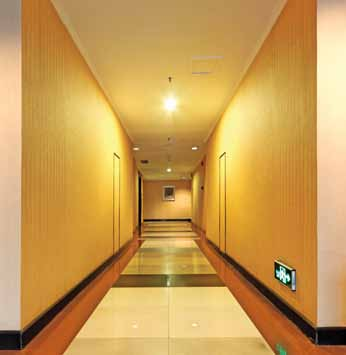
- Highly contrasting coloured strips may be laid in back offices, along the access corridors and emergency escape paths, to enhance the mobility of staff with vision impairments.
2. Where different materials are to be used for demarcating areas e.g. ramps, landings and approaching paths, it is important to ensure that the coefficients of friction are similar to minimise the risk of stumbling, especially for people with impaired mobility, such as the ones using crutches or other mobility aids.
3. Avoid too many patterns or textures on floor finishes and carpets, as these tend to confuse people with vision impairments and those with cognitive disabilities. Floor surface finishes with patterns that could be mistaken for steps or changes in level should be avoided.
4. Acoustic qualities of surfaces, such as sound absorption, become imperative when choosing floor finishes for lobby areas and conference halls/ meeting rooms, as these can enhance or diminish independence of guests with hearing impairments.
5. Surfaces that are highly reflective, especially when polished, have an adverse affect on people who can not withstand glare. This factor should be given utmost consideration when deciding floor finishes for the lobby. Moreover, reflections can mislead people, particularly those who are visually impaired.
6. Whilst the surface finish should be as smooth as possible to prevent tripping hazards and to provide an easy travel surface for wheelchairs; it must also be slip resistant, especially when spillage occurs.
- Cobbles, bare earth, sand and loose gravel should not be used on external approach paths, such as the route from accessible parking to the hotel entrance,
- For external ramps, slip resistant surfaces can be formed using several slabs of concrete or a similar base covered with an applied slip resistant coating (like paint, grit in an epoxy carrier etc.).
- The surface of an internal ramp should be covered with a slip resistant vinyl or rubber flooring which will provide the confidence for a disabled person to use the ramp.
- It is also important to ensure that regular cleaning and polishing do not produce a slippery surface.
7. If floor surfaces are carpeted, they should be firmly fixed with no loose edges, so as not to provide a tripping hazard for ambulant disabled people or people who are visually impaired. Deep piled carpets should be avoided.
Material |
Potential Dry & Unpolished |
for slip Wet |
Remarks |
| Carpet | Extremely low | Low | Loose or worn carpet can present a trip hazard |
| Cast iron | Low | Moderate to low | If open treads are used, the potential for slip can be low in wet conditions |
| Ceramic tiles (glazed & highly polished) | Low | High | |
| Ceramic tiles (matt) | Low | High | Wet slip resistance is dependent on surface roughness. An Rz (din) value of greater than10 pm is recommended for use in clean water wet areas |
| Clay pavers | Low | Moderate to low | |
| Clay tiles | Low | Moderate to low | When surface is wet and polished, the potential for slip can be very high |
| Clay tiles (carborundum finish) | Extremely low | Extremely low | May be suitable for external stairs |
| Clay tiles (textured) | Extremely low | Low | May be suitable for internal stairs |
| Concrete | Low | Moderate to low | If textured finish or a non-slip aggregate is used, potential for slip can be low |
| Concrete (powerfloat finish) | Low | Moderate | Surface dust may cause problems particularly on new floors |
| Cork tiles | Extremely low | Low | – |
| Float glass | Extremely low | High | Various techniques can be used to modify the surface of float glass, thus improving the wet potential for slip. Expert advice should be sought |
| Granolithic | Low | Moderate to low | Slip resistant inserts are necessary whenever granolithic is used for stair treads. Polished granolithic should not be used for stair treads |
| GRP profiles (chequer plate) | – | Low | Class determined by ramp method, water-wet with shop feet. No dry value determined. |
| Linoleum | Low | Moderate to low | Edges of sheet liable to cause tripping if not firmly fixed to base |
| Mastic asphalt | Low | Low | – |
| Profiled ceramics | Low | Moderate to low | Profiled ceramics are suitable for use in barefoot areas. |
| PVC | Low | High to Moderate | Ex-factory classes for PVC should be treated with caution. The installed floor is unlikely to be suitable for use in wet conditions. |
| Resin, smooth self-leveling | Extremely low | High to moderate | – |
| slip resistance | Extremely low | Resin, enhanced Low | The anti-slip properties depend upon sufficient, uniformly distributed aggregate. Areas of reduced aggregate can present a serious slip risk. |
| Rubber (sheets or tiles) | Extremely low | High | Not suitable near entrance doors or other foreseeable wet areas. |
| Rubber (smooth & ribbed) | Low | High | – |
| Stainless steel | Low | High | Wet slip potential is highly dependent on surface finish. Quoted values for 0.5 μm Rz (din) surface roughness. |
| Steel profiled (diamond plate) | – | Moderate | Class determined by DIN ramp method. No dry value determined. |
| Terrazzo | Low | High to moderate | Slip resistant inserts are necessary whenever terrazzo is used for stair treads. Polished terrazzo (including resin based) should not be used for stair treads. |
| Timber (finished) | Extremely low | High | Applies to sealed, or varnished, or polished timber. |
| Timber (unfinished) | Low | Moderate |
Summary
- Floor finishes should be even, smooth and uniform.
- Avoid reflective and slippery surfaces.
- Combinations of floor finishes with different textures should be used to aid persons with vision impairments to identify and differentiate the various areas, and to warn them of approaching hazards.
- Avoid heavy patterns or textures on floor finishes and carpets.
- Glare index, coefficient of friction and acoustic properties of surfaces should be considered when choosing floor finishes.
YOU MAY ALSO LIKE…
- Hotel Accessibility Manual – Accessible Parking
- Hotel Accessibility Manual – Main Entrance
- Hotel Accessibility Manual – Corridors
- Hotel Accessibility Manual – Ramps & Handrails
- Color and Luminance Contrast – Hotel Accessibility Manual
- Accessibility Business Centre and Conference – Hotel Accessibility Manual
- Accessiable Restaurant, Bar, Pub and Lounge – Hotel Accessibility Manual
- Pool Accessibility, Spa Accessibility and Health Club Accessibility
- Accessible Public Restroom Design
- Accessible Guest Rooms
- Accessible Emergency Egress
- Accessible Exterior surfaces and Interior Doors
- Signage
- Accessible Lighting
- Accessible Bathroom and Shower Room
Ref : Universal Design India Principles – ITC Hotels
Discover more from enabled.in
Subscribe to get the latest posts sent to your email.