
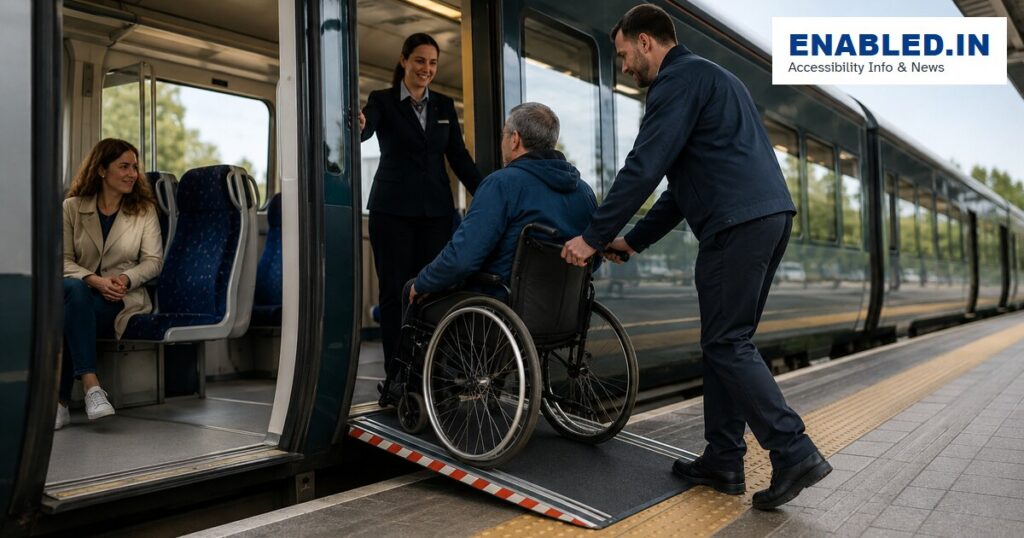
Quick answer: A practical guide to station access, assistance bookings, boarding, wheelchair spaces and accessible rail connections. Accessibility is individual, so verify every critical detail with the responsible provider.
Accessible tourism means that information, booking, transport, accommodation, attractions and support can be used safely and with dignity by people with different mobility, sensory, communication and cognitive requirements. This guide turns that principle into practical actions before, during and after a journey.
Check the route station by station
Verify step-free access
Check every departure, interchange and arrival station for lifts, ramps, platform gaps, accessible toilets and staffed hours. A route label alone may hide an inaccessible interchange.
Book assistance where required
Use the operator’s official assistance service, meet notice times and keep confirmation. Describe boarding, transfer, communication and luggage support accurately.
Reserve the right space
Confirm wheelchair-space dimensions, companion seating, priority seating and accessible sleeper or toilet availability. Mobility scooters may have separate size or weight rules.
Make boarding and connections workable
Arrive at the agreed meeting point
Allow time to find staff and platforms. Ask how boarding ramps or lifts will be deployed and ensure destination staff know you are arriving.
Plan for lift outages and changes
Check service updates before leaving and keep an alternative route. During disruption, ask the operator for an accessible replacement rather than accepting an unusable option.
Understand passenger rights
Assistance and compensation rules differ between countries and networks. Keep tickets and incident records, and use the operator or relevant enforcement body if support fails.
A practical planning timeline
Before booking
Check every station, interchange, platform and train type, not only the origin and destination. Record decisions in one accessible itinerary so the traveller, companion and providers work from the same information.
After booking
Reserve the correct wheelchair or priority space and request assistance through the official service. Record decisions in one accessible itinerary so the traveller, companion and providers work from the same information.
Before leaving
Check lift outages, platform alterations and disruption notices; save an accessible alternative route. Record decisions in one accessible itinerary so the traveller, companion and providers work from the same information.
At the station
Report to the agreed meeting point, confirm boarding equipment and ensure arrival staff are notified. Record decisions in one accessible itinerary so the traveller, companion and providers work from the same information.
Questions to ask before you pay
Use questions that describe function and process. Ask the provider to answer in writing, and keep the response with the booking.
- Is there step-free access to every platform used by this exact service?
- What are the wheelchair-space, door and boarding-ramp limits?
- Is an accessible toilet available and working on this train?
- How will assistance transfer across separate operators or tickets?
- What accessible alternative is provided if a lift or train is unavailable?
If the answer is vague, ask for measurements, photographs, equipment limits, staff procedures and the name of the person confirming the arrangement. An accessibility symbol alone cannot show whether a service matches an individual traveller.
Real-travel situation: what to do
A platform lift fails shortly before departure. Because the traveller checked live updates and arrived with time, staff can arrange an alternative station or accessible replacement transport. A tight unprotected connection would have made the same failure much harder.
When a barrier appears, first protect health and safety. State the required outcome clearly, ask for the responsible supervisor or assistance team, keep names and times, take photographs where appropriate and save receipts. If the issue is not resolved, use the operator’s complaint process and the relevant passenger-rights or consumer authority.
Common mistakes to avoid
- Checking only that the station is labelled accessible
- Assuming assistance automatically transfers between operators
- Boarding without confirming destination assistance
- Placing luggage in the wheelchair space
- Accepting replacement transport that the traveller cannot enter or use safely
A good accessible travel plan supports independence without removing choice. The traveller should decide what help is wanted, what information is shared and which backup option is acceptable.
Accessible travel checklist
- Define essential access requirements and preferred support.
- Ask precise questions and request written confirmation.
- Keep accessible offline copies of important information.
- Reconfirm arrangements shortly before departure.
- Allow extra time and prepare a workable alternative.
- Keep evidence of equipment condition, bookings and provider commitments.
- Check official rules for the countries, operators and services involved.
Frequently asked questions
How early should an accessible traveller start planning?
Start as early as practical, especially when accessible rooms, adapted vehicles, assistance appointments or equipment space are limited. Confirm provider-specific deadlines.
Should I rely on an “accessible” label?
No. Ask what the label means in practical terms and compare the answer with your own requirements. Measurements, photos and process details are more useful.
What information should I keep offline?
Keep bookings, assistance confirmations, emergency contacts, medication information and essential equipment details available in an accessible format even without internet access.
Do accessibility rights work the same way everywhere?
No. International principles support equal and dignified access, but legal rights, notice periods and complaint routes vary. Check official authorities for every country and transport mode involved.
Trusted sources and further reading
- UN Tourism: Accessible Tourism
- World Health Organization: Disability and health
- European Commission: Passenger rights
Rules and services vary by country and provider. Confirm current requirements directly with official authorities and operators before paying or travelling.
Discover more from enabled.in
Subscribe to get the latest posts sent to your email.