
Exemption of service tax on general insurance services provided under ‘Niramaya’ Health Insurance Scheme, launched by National Trust for the Welfare of Persons with Autism, Cerebral Palsy, Mental Retardation and Multiple Disability.
Certain assistive devices, rehabilitation aids and other goods for persons with disabilities and braille paper exempted of custom duty.
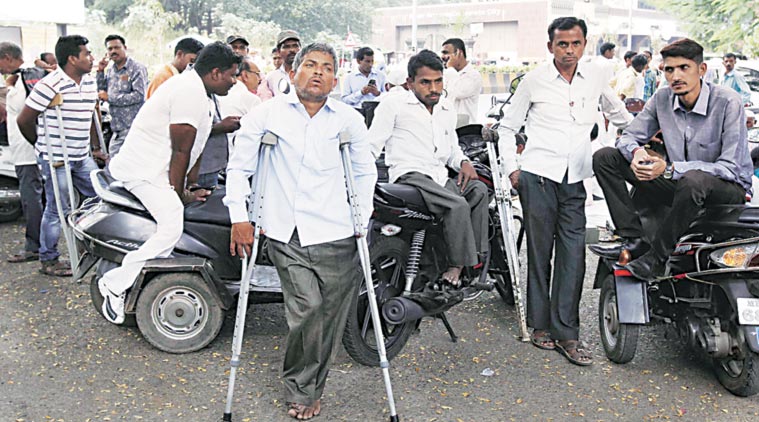
( Image Source : indianexpress.com )
Union Budget Allocation for Schemes of the Department of Disability Affairs (in Rs. Crore)
| Schemes | 2014-15 Actuals | 2015-16(BE) | 2015-16(RE) | 2016-17(BE) |
| DDRS | 50.08 | 54 | 47 | 40.5 |
| National Institutes | 133.45 | 118 | 158.18 | 162.74 |
| ADIP | 101.16 | 112.95 | 136.35 | 117 |
| PWD Act Implementation | 43.09 | 98.2 | 79.23 | — |
| Scheme for the employment of the physically challenged | 0.46 | 0.45 | — | — |
| Other programmes for the welfare of the physically handicapped | 15.94 | 44.79 | 53.8 | — |
| Post Matric Scholarship for students with disabilities | — | 10.8 | 9 | 7.2 |
| NHFDC | 36.58 | 31.5 | 31.85 | 27 |
| ALIMCO | — | 21 | 5 | 5 |
| RCI | 5.37 | 4.9 | 4.9 | 5 |
| Rajiv Gandhi Fellowship | 7.46 | 7.2 | 19.77 | — |
| Social Security and welfare | 36.58 | 145.18 | 54 | — |
| National Fellowship for Persons with disabilities | — | — | — | 17.55 |
| Pre Matric Scholarship for students with disabilities | — | — | — | 3.6 |
| Information and Mass Education | — | — | — | 70 |
| In Service Training and sensitisation, employment of physically challenged, national and state mission and awareness generation and publicity | — | — | — | 5.16 |
| Handling clearance of duty free consignment under bilateral agreement | — | — | — | 116.8 |
| Schemes for implementation of PWD Act 1995 | — | — | — | 45 |
| National University of Rehabilitation Science and Disability Studies | — | — | — | 45 |
| Other Programmes | — | — | — | 18.19 |
( Source: Union Budget and Economic Survey, Government of IndiaSource: Union Budget and Economic Survey, Government
of India )
More Details : Budget 2016 – Disability Benefits
The outcomes of Budget 2016 – 17 will potentially benefit a very small percentage of the population of persons with disabilities who can afford assistive devices from the market. How does it benefit the 80% of persons with disabilities who fall under the category of non-worker and marginal workers population (source: population census on non-worker population). This is the population that looks forward to a strong social protection programme for accessing quality assistive devices. The highlight of the budget according to the finance minister is offsetting the income loss due to direct tax exemption out of indirect taxes. This has a direct impact on persons with disabilities since a majority of them are non-workers, pensioners and marginal workers.
There was a mention of service tax exemption for group insurance under the Niramaya Scheme. Though the scheme benefits 20 percent of the population of persons with disabilities this exemption has no direct benefit to the said population and only benefits service providers. There are similar provisions for insurance covers for poorer households and senior citizens, and the concern is that there is no budgeting evident towards improving all levels of public health care. The much touted about Accessible India Campaign finds no mention in the budget speech. The disability movement is once again left with the question “Will my State ever become accessible?”
Key Policy asks from the disability movement:
- Statistics & Data disaggregation of financial allocation and physical performance across all departments and ministries similar to gender budget statement. Aggregating expenditure related to persons with disabilities under minor head across all departments and Ministries.
- Public procurement of all products, works and services are accessible for persons with disabilities.
- New schemes that assures services of personal assistants and supported decision making.
- Transitional programmes such as community based inclusive development as a flagship programme. This would facilitate deinstitutionalization of persons with disabilities and fulfil the obligation to live independently and being included in the community.
- Quality, accessible and affordable general and specific health care for all persons with disabilities as closest to the community as possible
- Ensuring social audits and bottom up planning.
(This section has been prepared by Equals – Centre for Promotion of Social Justice, Chennai.)
Source : Centre for Budget and Governance Accountability
Discover more from enabled.in
Subscribe to get the latest posts sent to your email.

Hi sir , i suffering from leg dissability ,can you sugest me for my future any job , i have done my mba in finance . Contact @ sahil _09910119103
dear sir
my son is mentally retarded challanged.i dont know where applly financial help??i,m in kerala